3 conversations 1 eye opening story from World of Coffee San Diego
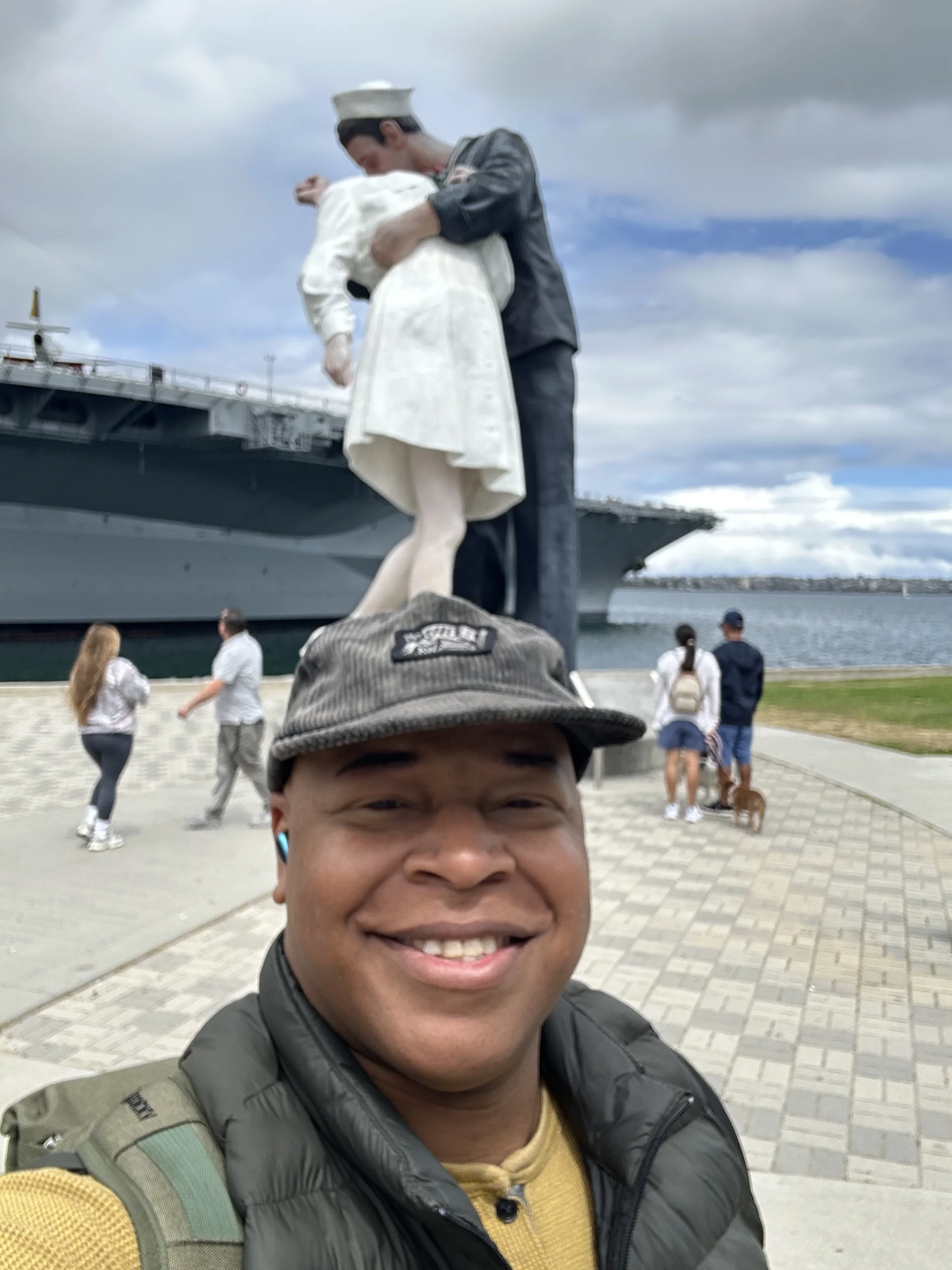
I apparently brought the weather from Seattle to San Diego with me so that was fun and I genuinely had zero expectations for World of Coffee but am happy to report that I left fully enlightened and looking ahead to what’s to come from it.
Coffee aside, I got to visit San Diego my new favorite California city for the first time which was pretty dope. I rapped over live beats at the cxffeeblack/Joe booth. Speaking of which I had a great time with my folks from Joe and cxffeeblack both at the show and away from it which could be a whole damn documentary. But anyway, between fishing for freebies I could stuff in my suitcase home and navigating the never ending sea of thousands of people, I processed things with no real goal in mind other than to let the show tell me what I needed to see and learn.
As you’ll read, it was…intriguing.
After walking up and down the aisles of vendors and exchanging the general niceties everyone engages in at a trade show I realize I didn’t exactly have anything to trade but I absolutely gained perspective about this current iteration of the coffee industry and how I can be a more productive citizen within it.
I had 3 separate, brief conversations with 3 people from complete opposite sides of the planet serving different sides of the coffee ecosystem. And the message I walked away with was stunning.
These conversations reinforced my sense of place in that, just as it’s been with the outdoor space, I’ve never felt like I’m a part of the coffee space cool kids. That’s never bothered me much, I still very much enjoy what we do I just know that no matter what, on some level, there will always be the old “square peg in a round hole” nature to our existence in these spaces. Not specialty enough, not this enough, not that enough. No matter how many boxes we check there’s always that undercurrent that boils down to because you don’t do or aren’t X you can’t be considered Y.
And I like it that way.
None the less, World of Coffee didn’t disappoint. I met some incredible people, saw some cool shit and here are the things I am leaving beautiful San Diego with.
Coffee Producers/farmers are 100% the best people in coffee.
Period point blank. I could sit in a trade show floor - or anywhere for that matter - with that group specifically and never tire of the warmth and love they show. It’s real, it’s genuine. It’s very…not what I observed us Americans do; which is immediately go into a sales pitch about why their thing is so great and buy buy buy! Yes, they want to sell you coffee this was a trade show after all. But there was a difference. It felt as though once they could sense YOU are genuinely interested in building with them they reciprocate with something I found to be immensely delightful.
While sitting and sipping some absolutely wonderful coffee with the Peruvians, then the Mexicans, then the Ethiopians, then the Hondurans, then the Kenyans then the Guatemalans, one single feeling kept coming back to me. It was the exact same as being in Hawaii and feeling that Aloha spirit for the first time. Yet, it was with people from every corner of the globe. If you’ve ever been to Hawaii and got to spend time with the Hawaiian people you know what I’m talking about. With that real aloha there’s a softness, an openness, a welcoming and a grounding or peace that comes with interacting with one another that can’t fully be described as anything other than real. And I think they sensed me, even though my badge said “Owner/Senior Executive” as a real dude -and that realness led to some real conversations.
I don’t know if anyone got candid conversation like I did but our non-American friends in coffee enlightened me about what American coffee culture looks like from afar…by holding up a mirror.
You know the scene in the movies when a high school aged character walks into the lunch room at their school and with every passing table, the people at those tables point and giggle, or lean over and whisper something to their friend while giggling? The camera moves slow, panning from table to table to the character and you can almost feel the embarrassment along with them?
Yea, we’re that character. Except you could make the argument that for most of us, we don’t know we’re that character because we’re walking around with our American exceptionalism glasses on and maybe we also instinctively know that in a space like this, we’re the marks. So even if we are the butt of the joke, it’ll be in private because here, we’re the stars. On one hand you could say that’s just me admitting my own shortsightedness, however this enlightenment isn’t exactly new, It echoes conversations I had years ago with people around the coffee world after my first coffee trade show in 2020, the light had just faded slowly over time and was eventually pushed to recesses of my mind. This weekend just laid it bare in front of me again.
3 conversations with 3 people from across the globe - one purely comedic conversation with an Italian gentlemen led me to a bigger thru line.
The first conversation was with an Aussie. Well, I’m assuming he’s an Aussie, he had an undeniable accent and I overheard him mention to another attendee something about going back to the Sydney area. It was more of a group convo with myself and a younger couple that kinda had that “hip coffee shop barista/maybe I’m a van life influencer” vibe. Midway through they’d walk away but I stayed when he said something profound about American cafe operators and how we approach our equipment. How when he works with us Americans he’s noticed we tend to think about brand names and how we will be perceived by the customer before we think about function. He mentioned how American coffee roasters default to names like Loring and in coffeehouses we default to LaMarzocco. And a lot of times we just do it because that’s what’s being done. Yes, those are great names that have good reputations for the right reasons but do we ever stop to think why THAT name is a good fit for us versus another? We usually (not always), especially new operators, don’t think about how a machine actually works with our space until it’s too late if at all. The power requirements may not match. The sizing may not match. The functionality and features may be bloated or not a good fit for what we actually do or the customer we serve. He’d worked with a number of customers who, after discovery, could go with something that would check every box of what they actually need and skip it if the name on the plate isn’t what they’ve already told themselves they NEED to have. That kinda hit home because in our shops we don’t have LaMarzocco espresso machines. We do however have Wega and Simonelli machines. Still solid brands but we got them for no other reason than they check the boxes.
He knows we, no matter how mind-boggling it may be, think about what a brand name signals FIRST. The way he said it was like he believes it is a uniquely American trait. And though a tiny part of me felt the urge to push back because keeping it real, I’m too broke to operate like that 😂😂 it’s a trait I find on coffee business owner groups across the internet. There are countless coffee shop threads where someone will ask about the type of equipment they should be looking at and multiple people will make mention about how they will walk out of a shop if they don’t see XYZ brand on the counter because without it, they must not be “serious” about coffee or something to that affect.
Isn’t that a weird thing to do? That’d be like me making a bet that the Seattle Seahawks will lose a game solely based on the fact the QB is wearing a certain shoe brand. Those aren’t Nikes? He’s gonna throw 7 interceptions today. Sounds ridiculous but thats the logic.
The next conversation was with an Ethiopian gentleman who imports coffee and we spoke about the ritual of coffee and how in his home country the coffee is simply to be shared. As he was telling me about the coffees he had displayed I asked which of them was the best of the best? He gave me a nervous laugh and said all of them. It’s whatever YOU like. No matter what region, if it comes from Ethiopia they’re all to be shared. You give your best and you share it. That struck me because in America THAT becomes a way to sort people and I automatically reverted to that thinking when I asked him what his best was.
Our best coffees are not shared with the same intentionality as something that may or may not be deemed as high of quality by our Q graders…once it’s considered “superior” that immediately commands a higher price and therefore eliminates the amount of people who can experience it. The gentlemen made a comment that I can summarize as ‘THAT is a purely western paradigm’ and to his point; “hey we charge more so we make more money too”. In other words we can play your game, but in our daily ritual of coffee, we share.
I interpreted that as they approach sharing coffee with a depth that is led with love and openness and naturally accessibility follows and that doesn’t need a price tag to match.
What a novel concept right? Here’s this really good thing I have, let me share it with you. Not “hmmm…which one of these am I going to get the highest return on?” And even if that was the approach, by his logic, sharing the best would still garner the best return because, well, the people would come back for more.
The final convo I wanna bring up was by far the funniest but also probably the most sobering (I know that word makes it seem like it took a sad turn, it didn’t, I promise) and it was with an Italian gentlemen who builds roasters. I was geeked and we geeked together on roaster technology but somehow again, we ended up discussing the differences of American coffee culture and the rest of the world’s coffee expressions before handing me off to his American counterpart.
Now before we go any further, I gotta say I dunno if there is a group more prideful of their contributions to the coffee world than the Italians. They’re well aware that ours - as is most westernized coffee culture, is rooted in, albeit a bastardized version of, the Italian coffee methodology.
My Italian friend, like the Aussie, initially mentioned how we Americans love to fall for a good marketing campaign of which he said he was admittedly bad at and that statement was followed by a more crass version of what the Ethiopian gentlemen alluded to in that “you say you love quality in the US but in the end do you REALLY?” They say “Americans will buy it as long as we say it’s better than (fill in the blank)’ and the US is a big market so we’re happy to sell it to you.”
My guy was not wrong at all. Feed our need for superiority and we’re as good as sold.
To understand the comedy of it all you have to kind of picture him. Short, slender, 100% gave off the typical Italian loverboy in the movie vibes. Like the guy who sleeps with the married chicks while they’re on some Italian countryside vacation and disappears to leave them broken hearted rethinking their decisions. He had the long hair and tan skin, talked with his hands a lot, wore a nice suit and in his Italian accent was as good a conversationalist as he was a technician. He cracked jokes about Americas drive thru coffee culture, our “nuts and oats” in our milks and our “big sugary milky drinks” which are all accurate and you had to be there to hear him talk about it. It was comedy. Because as much as he ragged on it he also said “that’s okay it’s good it’s good” a lot. As if it tamper it all down.
But the more striking thing he pointed out was the baristas. I’m paraphrasing but he mentioned how if you go to a bar (for alcohol), the bartender has to know how to make the most basic of drinks. That’s standard. A cosmopolitan, an old fashioned. You have to make them really well before you move on to anything else. But to him, it’s funny that in America - as he observed, the baristas in the drive thru (he called it “drive thru shenanigans”) can barely steam cappuccino foam but they want to offer 40-oz-nut-milky-syrup-drink with very little coffee (insert “but that’s okay, it’s good it’s good). He mentioned how he wanted a long black at a coffee house here while at world of coffee and the barista had no clue what it was. It’s just a reverse Americano.
Now to his point, I’ve always been of the mind that drive thru coffee stands and coffee houses are two totally different things even if they both have coffee in the name, and there are drive thru baristas who certainly can steam cap foam, but to hear that from someone who lives half a world away was sobering even if it is true. For one, how did we get here? Where there are so many places that have coffee in the name but barely show any expertise in coffee? For two, It made me think damn I don’t know if our crew knows what the difference between a long black and an Americano is my damn self. Now to be fair a long black is not exactly a common order here so that’s to be forgiven - in all my years behind a bar I might’ve sold 2. But again, point taken, he was right. And I’ve always shared that sentiment; if you actually sell energy drinks and SOME coffee put energy in your name not coffee. It’s misleading. It’s just something about the way he positioned the barista who can’t make what would be a very standard drink, may not even know what it is, but with wizardly precision come up with a crazy iced drink flavor combo - and it’s common that stuck with me.
Blame social media or just the culture of TikTokable drinks but what I could distill from his observation was that complexity seems to be the thing we aim for before the basics are mastered. Mastery takes a long time, I get it. And those drinks are fun. And look, I’ll be the first to admit I don’t give a good got damn about latte art nor do I care about brands the way some owners do but isn’t all of that just signaling anyway? When all that really matters is the execution of the drink in the cup? The service provided? The feeling?
Then as an aside bonus convo, while talking with the Peruvians, I bumped into an American who was representing Hawaiian Coffee who made the contrast super clear (not a Hawaiian). In talking to me he made a point to say “hey you might be small fries for us but you should go have some coffee at our booth.” And he turned away to have another convo. So in one sentence, I was told I was too small to entertain a conversation, and once that was determined he basically asked me to leave by saying to finding his booth and have some coffee.
And to boot he gave me the wrong booth number.
I couldn’t even get the decency of a good joke like I did from my Italian friend, or the courtesy of a lesson on community like I got from my Ethiopian friend or the peeling back of the curtain so to say that I got from my Australian friend. Let alone any type of warmth from a guy representing Hawaii. This man determined my presence didn’t warrant his attention once he determined I was “small fries”.
So after distilling all of these interactions down, the point emerged:
American coffee culture, much like American culture in general, is a different animal than what the rest of the world experiences. Even when we’re experiencing the same thing. In this case, coffee. Yet there’s a strange duality of wanting to partake in the Americanized playground of it all, but not be absorbed by it not even in part.
After all, the world and each of our experiences inside this community are far more nuanced than these 3 convos, (4 if you count the fellow American) but on a closer look, thru lines start to emerge. Where much of the world seems to lead with openness, care, and a kind of human-centered way of existing with one another even when it comes to the most technical aspects of coffee…we tend to lead with competition. We try to outdo and out signal each other. Not all of us - but enough of us. You know the vibe.
You know exactly who I’m talking about when I say we have leaders in this industry who “honor” producers by turning their coffee into the biggest, sugar-iest concoctions commodities, built for scale, built for volume, built for anyone willing to buy. And oop! Also have done the same to matcha and chai but those are other stories all to themselves.
And you also know how we go to the other end of the spectrum. Where we, in a weird way, co-sign ourselves onto the coffee producer’s mastery using the language of “premium,” of “craft,” of whatever “wave” we’re in—to position ourselves as elevated…while excluding the very people we claim to want to bring into the ritual. Our own neighbors.
And for the smallest amongst us, the neighborhood shop operator who wants to build something cool, we jump in one camp or the other and follow suit in order to survive. Because capitalism.
And then we post about it on TikTok because, of course.
Isn’t that all…strange?
I’m still trying to make sense of it all if you couldn’t tell but what I believe it all boils down to is: America is just a code word for commerce and we don’t even try to hide it. And even though I feel like I already align myself in that way I can be better.
We perform for social media and in coffee that tends to look like.
The most outrageous everything. Just for the sake of it.
The hippest cafe interiors. Aesthetics just for the sake of aesthetics, lessening each design choice to mere decoration instead of serving purpose because who needs purpose when all we need are signals?
We signal for status. We beg for attention. And why? Where’s the heart?
I used to say this when I was in music:
No one ever bought an album because it was recorded on a Neve console - shoutout to you if you know what that is. They bought it because it made them feel something. But somewhere along the way, in business, in coffee, in life we started believing that the symbols are just as powerful as the real thing. And maybe to some degree that’s true.
And the strangeness continues to reveal itself the closer you look.
We function in systems built on hierarchies with a clear top and bottom and barely functioning middle. They function in circular communities like co-ops and collectives that are built on contributions.
The global coffee community reminded me this weekend that they understand how to live inside the ritual. And through jokes, I gather we’ve gotten very good at monetizing it as a product.
Their hospitality is built around the human.
Now I will say, many of us try to do this in earnest, even the big green mermaid, but we can’t help but center the transaction, the metrics, the speed, the volume into all of it.
And I can’t help but wonder
When having to choose between terrible capitalism and awful capitalism is there really a better way for us here?
And as an aside, is it possible that we toss around these craft and artisan labels as just more marketing terms that do the job of more signaling of status without actually seeking mastery of craft and artisanship?
Because as much of this experience this weekend showed…there is a difference and maybe we’re the ones who haven’t adapted to the program even if we’ve mastered acting like we have.